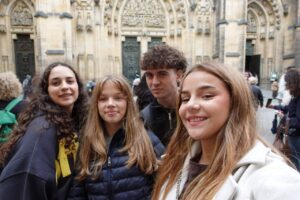
Nuestro diario Erasmus durante 3 semanas en Chequia
Autores: Mario Ruiz, Andrea Albiñana y Marta Moreno.
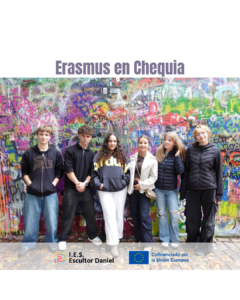
El instituto en la República Checa (Marta)
Durante nuestras tres semanas en la República Checa, pudimos conocer su instituto y descubrir muchas diferencias con respecto al nuestro.
En primer lugar, los horarios son bastante diferentes. No tienen el mismo horario todos los días, sino que va cambiando. Algunos días tienen nueve clases, mientras que otros solo tienen seis. Las clases siempre empiezan a las ocho de la mañana y muchos alumnos viven bastante lejos del instituto, por lo que tienen que madrugar mucho.
Otra diferencia importante es que los alumnos tienen más libertad. Los profesores les permiten utilizar el móvil durante las clases y, además, tienen más descansos a lo largo del día. Tanto los profesores como los alumnos son muy agradables y cercanos, por lo que desde el principio nos sentimos muy bien acogidos.
También nos llamó la atención que las clases son más dinámicas y participativas que en España. Los alumnos intervienen más y realizan diferentes actividades, lo que hace que las clases sean más entretenidas.
La asignatura de Educación Física también es muy diferente. Los chicos y las chicas tienen las clases por separado y practican distintos deportes. Además, cuentan con un gimnasio equipado con mancuernas y máquinas, y organizan competiciones deportivas entre los alumnos.
En cuanto a las instalaciones, el instituto es mucho más grande que el nuestro, a pesar de tener menos alumnos. Dispone de muchos espacios donde los estudiantes pueden sentarse y descansar; incluso hay bancos en los pasillos. En el exterior cuentan con dos campos de fútbol y una pista de atletismo.
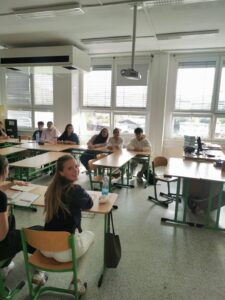
Durante nuestra estancia, asistimos a clases de inglés junto a nuestros compañeros de intercambio. También tuvimos la oportunidad de participar en otras clases con diferentes alumnos y profesores. Algunas veces estuvimos con estudiantes que tenían un nivel de inglés superior al nuestro y otras con alumnos de un nivel parecido. En estas clases tratamos temas variados, como la historia y la tecnología. En total, tuvimos clase con tres profesores de inglés diferentes. Además, asistimos a algunas clases de español, donde ayudamos a los alumnos a practicar el idioma.
Para poder hacer nuestros deberes, el instituto nos dejó utilizar una parte de la sala de profesores. Era una sala bastante amplia, con buenas vistas y una máquina de café.
En general, visitar su instituto fue una experiencia muy enriquecedora, ya que pudimos conocer de cerca un sistema educativo diferente y comparar sus costumbres con las nuestras. Además, nos gustó mucho conocer a los alumnos, que desde el primer momento fueron muy amables y nos hicieron sentir como en casa.
Viajes por Chequia (Andrea)
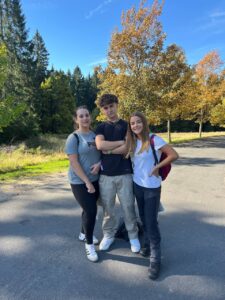
Durante estas tres semanas también tuvimos tiempo para recorrer la República Checa y descubrir algunos de sus lugares más bonitos. Tuvimos la gran oportunidad de visitar los montes del norte de Bohemia con nuestros compañeros de clase, aprovechando una excursión que tenían organizada.
La excursión consistía en explorar los montes de Bohemia y, para ello, pasamos tres noches en un pueblo del norte de la República Checa. Durante esos cuatro días, además de visitar la zona, tuvimos tiempo para conocer mejor a nuestros compañeros, lo que hizo que nuestras dos últimas semanas fueran todavía mejores. Pudimos hacer nuevas amistades con los que esruvimos después toda la movilidad.
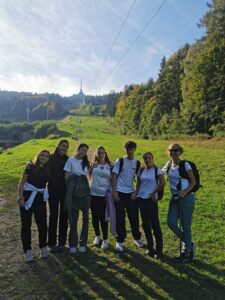
Además de hacer una ruta por la montaña y subir hasta la cima de uno de sus picos, también visitamos un museo, fuimos a unas piscinas y dedicamos un día a ir de compras por un pueblo de la zona. Nos lonpasamos muy bien.
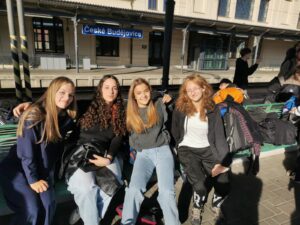
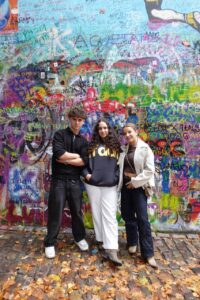
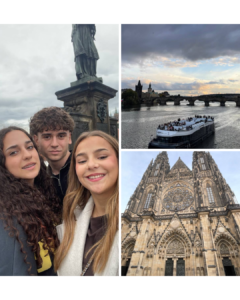
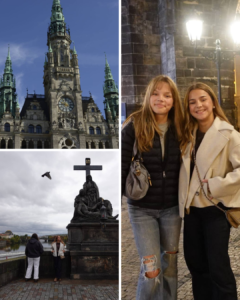
Otro fin de semana, nuestros compañeros Kamila, Rosta y Julia hicieron posible que visitáramos la capital, Praga, donde pasamos un día haciendo turismo. Visitamos algunos de sus monumentos más importantes, como el Puente de Carlos y el Castillo de Praga. También nos dimos cuenta de que la ciudad, sus edificios y su estilo arquitectónico eran muy diferentes a los de España.
Otra cosa que nos sorprendió fueron sus horarios, ya que, a la hora a la que normalmente en España sales a la calle y encuentras a todo el mundo disfrutando del ambiente de los bares, en Praga, a pesar de ser la capital, a las nueve de la noche parecía que estaba todo muerto: ¡no había ni un alma por la calle!
El segundo día en Praga, después de pasar allí la noche, fuimos de compras a un centro comercial. Sin embargo, salvo algunas excepciones, las tiendas eran las mismas que en España y los precios, en general, eran iguales o bastante parecidos.
Básicamente, lo que descubrimos durante estos dos fines de semana es que, aunque la República Checa nos ha encantado y hemos disfrutado muchísimo de la experiencia, ¡no cambiaríamos el ambiente y el estilo de vida españoles por nada!
La comida (Mario)
Durante nuestro viaje a la República Checa, hemos podido comprobar que tienen una cultura bastante diferente a la nuestra. Las diferencias más notables las hemos encontrado en la comida, los horarios, las tradiciones y las costumbres.
Lo que más nos ha llamado la atención, al menos a mí, y aunque ya sabíamos que era habitual en la mayoría de los países de Europa Central, son los horarios de las comidas. El desayuno lo hacen más o menos a una hora similar a la nuestra, ya que se levantan a la misma hora, entre las 6:00 y las 8:00 de la mañana. Sin embargo, suelen comer alrededor de las 12:00 o, como muy tarde, a las 13:00. Un día que terminamos las clases muy pronto, nuestros compañeros checos llegaron a comer a las 10:30 de la mañana, aunque nosotros preferimos hacerlo fuera del instituto, sobre las 11:30 o las 12:00.
En cuanto a la cena, no tienen una hora fija. Prefieren cenar cuando llegan a casa después del trabajo o de la escuela, lo que suele ocurrir entre las 17:00 y las 19:00.
Desayunan de forma bastante parecida a nosotros: café y, a veces, tostadas, aunque con mantequilla, claro, ya que el aceite de oliva allí es bastante caro y están más acostumbrados a utilizarla.
En la República Checa, tanto en la comida como en la cena, es muy habitual tomar sopa. Durante nuestra estancia he probado sopas de guisantes, col, ternera, pollo, rábanos, setas y muchas otras variedades elaboradas con verduras, legumbres y carnes.
Uno de mis platos favoritos ha sido el Schnitzel (Řízek), un filete de ternera o pollo empanado que, en realidad, es de origen austríaco. Lo mismo ocurre con el Strudel, cuya versión checa, llamada štrúdl, es una especie de tarta de manzana horneada.
Su plato nacional es el Svíčková na smetaně, que consiste en un filete de ternera acompañado de una salsa espesa de nata y de dumplings. Estos últimos son un tipo de masa cocida muy particular que no voy a intentar describir para no cometer ningún sacrilegio.
Our Erasmus Diary:
Authors: Mario Ruiz, Andrea Albiñana and Marta Moreno
Life at a Czech school (Marta)
During our three weeks in the Czech Republic, we had the opportunity to visit their school and discover many differences compared to ours.
First of all, their timetables are quite different. They don’t have the same timetable every day; it changes from one day to another. Some days they have nine lessons, while on other days they only have six. Classes always start at 8 a.m., and many students live quite far away from school, so they have to get up very early.
Another important difference is that students have more freedom. Teachers allow them to use their mobile phones during lessons and, in addition, they have more breaks throughout the day. Both teachers and students are very friendly and approachable, so we felt very welcome from the very beginning.
We were also surprised to see that lessons are more dynamic and interactive than in Spain. Students participate more actively and do different activities, which makes lessons more enjoyable.
Physical Education is also quite different. Boys and girls have separate lessons and practise different sports. The school also has a gym equipped with dumbbells and machines, and they organise sports competitions among students.
As for the facilities, the school is much bigger than ours, even though it has fewer students. There are many areas where students can sit down and relax; there are even benches in the corridors. Outside, there are two football pitches and an athletics track.
During our stay, we attended English lessons with our exchange partners. We also had the opportunity to join other classes with different students and teachers. Sometimes we were with students whose English level was higher than ours, while on other occasions we joined groups with a similar level. In these lessons, we covered a variety of topics, such as history and technology. In total, we had lessons with three different English teachers. We also attended some Spanish lessons, where we helped students practise the language.
The school allowed us to use part of the staff room to do our homework. It was quite a large room, with a lovely view and a coffee machine.
Overall, visiting their school was a very enriching experience because we were able to discover a different education system first-hand and compare their habits and customs with ours. We also really enjoyed meeting the students, who were very friendly from the very beginning and made us feel at home.
Travelling around Czech Republic (Andrea)
During these three weeks, we also had time to explore the Czech Republic and discover some of its most beautiful places. We had the amazing opportunity to visit the mountains in northern Bohemia with our classmates, joining a trip they had organised.
The trip was all about exploring the Bohemian mountains, and we spent three nights in a village in the north of the Czech Republic. During those four days, as well as exploring the area, we had time to get to know our classmates better, which made the last two weeks of our stay even more enjoyable. We made new friends, whom we continued spending time with throughout the rest of our mobility.
Apart from going hiking in the mountains and reaching the summit of one of the peaks, we also visited a museum, went swimming at a swimming pool and spent a day shopping in a nearby town. We had a really great time!
Another weekend, our classmates Kamila, Rosta and Julia made it possible for us to visit the capital city, Prague, where we spent a day sightseeing. We visited some of its most famous landmarks, such as Charles Bridge and Prague Castle. We also realised that the city, its buildings and its architectural style were very different from those in Spain.
Another thing that surprised us was their daily routine. In Spain, when you go out in the evening, you usually find lots of people enjoying the lively atmosphere of the bars. However, in Prague, even though it is the capital city, at nine o’clock in the evening everything seemed completely deserted. There was hardly anyone in the streets!
On our second day in Prague, after spending the night there, we went shopping at a shopping centre. However, apart from a few exceptions, the shops were the same as in Spain and, generally speaking, prices were similar.
Basically, what we discovered during these two weekends is that, although we absolutely loved the Czech Republic and really enjoyed the whole experience, we wouldn’t swap the Spanish atmosphere and lifestyle for anything!
Food (Mario)
During our trip to the Czech Republic, we realised that their culture is quite different from ours. The most noticeable differences were related to food, mealtimes, traditions and customs.
What surprised me the most, although we already knew this was common in most Central European countries, was their mealtimes. Breakfast is usually at more or less the same time as in Spain, as people get up at a similar time, between 6 and 8 a.m. However, they usually have lunch at around 12 noon or, at the latest, 1 p.m. One day, when we finished classes very early, our Czech classmates went for lunch at 10:30 a.m.! We preferred to eat outside the school, at around 11:30 a.m. or 12 noon.
As for dinner, they don’t have a fixed time. They prefer to have dinner when they get home from work or school, which is usually between 5 and 7 p.m.
Breakfast is quite similar to ours: coffee and sometimes toast, although they usually have it with butter, of course, because olive oil is quite expensive there and they are more used to using butter.
In the Czech Republic, it is very common to have soup for both lunch and dinner. During our stay, I tried pea, cabbage, beef, chicken, radish and mushroom soups, as well as many other varieties made with vegetables, pulses and meat.
One of my favourite dishes was Schnitzel (Řízek), a breaded veal or chicken fillet which actually originated in Austria. The same goes for Strudel, whose Czech version, called štrúdl, is a kind of baked apple pie.
Their national dish is Svíčková na smetaně. It consists of beef served with a thick cream-based sauce and dumplings. These are a very particular type of boiled dough, which I won’t even try to describe because I don’t want to commit a culinary sacrilege!